
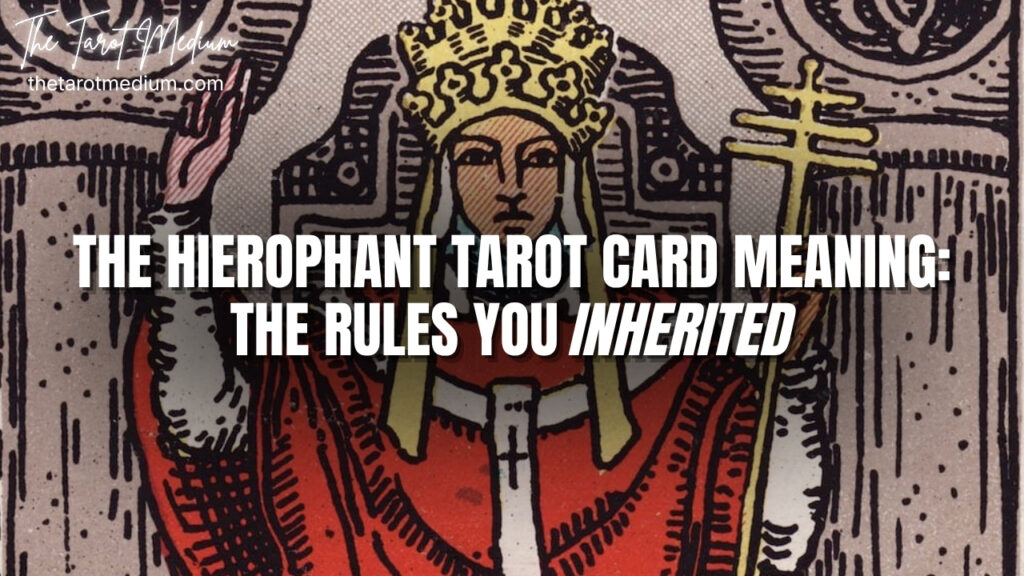
The Hierophant Tarot Card Meaning: Upright & Reversed
Keywords, Symbols, Colors, Astrology, Love, Timing & Yes or No
Two fingers point to heaven, two fold toward the earth. Seated between his own pair of pillars with two acolytes at his feet and two crossed keys below them, The Hierophant has never once kept a secret to himself.
Most people meet this card when they’re deciding whether to follow the rules, leave the faith, or find a teacher who actually knows the way.
Welcome to the sixth entry in my tarot glossary.
The Fool leapt, The Magician built, The High Priestess listened, The Empress grew, The Emperor framed it, and now the tarot deck asks who taught you everything you believe.
Below you’ll find the card’s symbols, its color psychology, upright plus reversed meanings with keyword lists, what he means in love or as feelings, how other cards amplify or diminish him, his planet, his zodiac sign, timing, whether he leans yes or no, and my own intuitive read after years of pulling him for clients.
Stay to the end to see what this card holds for anyone whose faith changed shape after a loss.
Want to read The Hierophant without a guidebook open beside you? These online tarot courses teach you how to read tarot cards intuitively, no memorizing required.
Keeping notes as you learn? Join the newsletter for your own free tarot notebook, every good student’s first tool.
Considering a reading instead? Click here to book yours.
NEVER HAD A READING WITH ME BEFORE?
The Hierophant holds the keys to heaven and spends his days explaining them to two students, which is either great generosity or the longest staff meeting ever held.
Click here to read what to expect from a reading with me: the tone, boundaries, and a clear scope of what I do.
For deeper guidance, exclusive offers, and first access to my most requested reading spots, click here to join my email list.
Think of it as teaching passed hand to hand rather than down from the chair. I only send what is meaningful, never spam, I promise.
THE HIEROPHANT AT A GLANCE
NumberFive, Major Arcana
PlanetVenus, through Taurus
ZodiacTaurus
ElementEarth
TimingSlow and steady, weeks to months
Yes or noYes, by the book
UprightTradition, guidance, teaching, shared belief
ReversedDogma, rebellion, breaking convention
JUMP TO A SECTION
MeaningSymbolsColorsUprightReversedLove & FeelingsCard CombinationsYes or NoTimingAstrologyLife LessonsQuick Answers
What Does The Hierophant Tarot Card Actually Mean?
The Hierophant is card five of the Major Arcana, the moment the soul stops learning alone and joins a lineage.
Five breaks the stable square of four. This card answers the disruption with teaching, tradition, plus a community that has seen it all before.
Picture wisdom with a waiting room and office hours.
The keeper of the keys
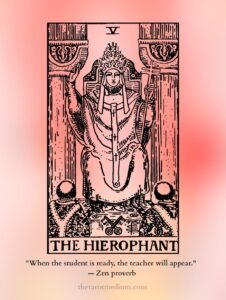
In the Rider Waite Smith image, a robed pope figure raises his right hand in blessing between two stone pillars, while two tonsured acolytes kneel below and two crossed keys rest at his feet.
Everything The High Priestess guards behind her veil, he translates out loud.
The Hierophant exists to make hidden things teachable, which is both his strength and his limitation.
The figure descends from the Pope card of early Italian tarot decks, renamed when tarot moved from parlor game to spiritual practice.
Rachel Pollack’s 78 Degrees of Wisdom reads him as the doorway between inner truth and outer teaching, a church door that swings both ways.
What Are the Symbols on The Hierophant Tarot Card?
Pamela Colman Smith packed this card with ceremony.
Every object here speaks the language of transmission, knowledge moving from one generation into the next.
- The triple crown: authority over the conscious, subconscious, and superconscious mind, three worlds stacked in gold.
- The triple cross scepter: the papal cross, dominion expressed through blessing rather than force.
- The raised hand: two fingers up, two down, the same “as above, so below” gesture The Magician makes with his wand.
- The crossed keys: the keys to heaven, conscious and subconscious unlocked together. Knowledge is meant to be handed over.
- The two acolytes: the roses of desire and the lilies of pure thought embroidered on their robes, two kinds of students before one teacher.
- The two grey pillars: law beside liberty, obedience beside disobedience, the frame every tradition builds around its members.
- The red robe: the living heart of the institution, passion formalized into ritual.
- The white trim and shoes: purity threaded through the ceremony, the clean intention underneath the pageantry.
- The number five: the human hand, the five senses, the disruption that sends people looking for a teacher in the first place.
What Do the Colors on The Hierophant Card Mean in Psychology?
Color does quiet work on the mind before a single meaning gets read.
Psychologists have long tied specific hues to specific responses, and this palette reads like a formal ceremony feels.
THE HIEROPHANT COLOR PALETTE
Each color is pulled from the card itself, with what it tends to stir in you.
Cardinal red seen in the outer robe
Devotion with a pulse, the felt intensity underneath ritual.
Gilded gold seen in the crown, keys
Value and permanence, everything a tradition has preserved.
Cathedral grey seen in the pillars
Neutrality and endurance, built to outlast every member.
Altar white seen in the trim, collars
Clean intention, the purity a teaching keeps when it stays honest.
Sapphire blue seen in the robe beneath his red one
Trust and receptivity, the state that makes learning possible.
Sage green seen in the robes
Growth, a faith that stays alive rather than fixed.
 ↑ UPRIGHT
What Does The Hierophant Mean Upright?
Upright, The Hierophant is guidance you don’t have to invent from scratch.
A mentor, a tradition, a course of study, a community that already holds the map you’ve been trying to draw alone.
Structure meets spirit here, and the meeting is usually a relief.
Find the teacher, or become one
Belonging is the quiet engine of this card.
The Hierophant knows that some things only transmit person to person, which is why every tradition worth keeping comes with people attached.
When this card turns up, something in your life is asking you to learn from those who walked first, or to start teaching what you’ve already survived.
Most upright Hierophant keyword lists land on the same handful of words: tradition, conformity, spiritual guidance, institutions.
That tracks with what I see when he arrives for someone tired of figuring everything out by themselves.
The Hierophant upright at a glance
- Core meaning: wisdom that arrives through a teacher, a tradition, or a community rather than alone.
- Relationships: commitment with witnesses, shared values, often marriage or a bond blessed by both families. Partnership that follows a known form.
- Career and finances: mentorship, certification, an established employer, advice worth paying for. Conventional routes outperform clever shortcuts right now.
- Health: proven approaches over experiments, a practitioner you trust, the boring routine that actually works. Read it as guidance rather than diagnosis.
- Spiritual: study within a lineage, ritual as an anchor, the comfort of prayers other people have said before you.
UPRIGHT KEYWORDS
tradition spiritual guidance teaching mentorship institutions shared belief conformity marriage ritual community
CARDS THAT STRENGTHEN IT
- Three of Cups fills the pews with actual friends.
- The Emperor gives the teaching a structure that holds.
- Ten of Pentacles turns tradition into legacy with a family attached.
CARDS THAT DIMINISH IT
- The Fool wanders off halfway through the sermon.
- Seven of Swords keeps one foot outside the congregation.
- The Tower brings down the very institution the card was leaning on.
“When the student is ready the teacher will appear.”
Attributed to Lao Tzu“Tradition is not the worship of ashes, but the preservation of fire.”
Gustav Mahler
How Do Other Cards Amplify or Diminish The Hierophant?
No card reads alone. In every spread, the neighbouring cards either reinforce The Hierophant’s teaching or challenge it.
This is called adjacency: two or more cards working in unison, building one cohesive story instead of a list of single card definitions.
When The Hierophant gets amplified
An amplifier speaks his language. Commitment beside commitment, study beside study.
- The Hierophant + Four of Wands: a ceremony worth celebrating, very often a wedding.
- The Hierophant + Eight of Pentacles: devoted study, an apprenticeship, a course that genuinely changes how you work.
- The Hierophant + Two of Cups: a bond made formal, two people choosing to make vows.
When The Hierophant gets diminished
A diminishing card pushes back. It questions, rushes, or outgrows the structure The Hierophant is trying to hold.
- The Hierophant + Five of Wands: disagreement inside the group. Everyone has an opinion about the rules.
- The Hierophant + Knight of Swords: impatience with the process. You want the answer without the lesson.
- The Hierophant + Ace of Wands: a new spark that won’t fit inside the old form.
When two cards disagree, don’t pick a winner. Acknowledging the disagreement is the reading.
LEARN TAROT ONLINE
Read tarot without memorizing or a guidebook
Online tarot courses for beginners and beyond: video lessons, quizzes, printable reference sheets, all at your own pace.
Is The Hierophant a Yes or No Card?
Yes, by the book.
The Hierophant answers yes when the path runs through approved channels, and hesitates the moment you propose a shortcut.
His yes favors the marriage over the fling, the certification over the hack, the established route over the improvised one.
Reversed, the answer shifts toward no, or toward a yes that requires you to break formation first.
In a live reading I steer away from flat yes or no answers anyway, since your free will does the real work and no card gets to choose on your behalf.
Speaking in glossary terms, though, this card leans toward a formal, fully documented yes.
What Is The Hierophant’s Timing in a Tarot Reading?
Timing under The Hierophant moves like a semester rather than a lightning strike.
Taurus rules here, and Taurus has never rushed anything in its life.
Expect developments measured in weeks and months, arriving through proper channels with all their paperwork intact.
Slow, steady, and stamped by the registrar
Taurus season is the traditional window, roughly late April into May, when spring settles in and stays.
Five is the other timing clue, showing up as five days, five weeks, or five months depending on the question.
When I see The Hierophant for timing, I read it as procedural.
Things happen once the ceremony, the course, or the approval process runs its full course.
What Planet and Zodiac Sign Rule The Hierophant?
The Hierophant belongs to Taurus, the sign that builds to last.
Venus rules Taurus, which threads something surprising through all this ceremony: the tradition survives only because people love it.
Astrologers tracing the Taurus current through this card tend to find the same patient, sensory devotion.
Earth is the element tying it together, teaching made tangible through bread, wine, beads, candles, and books you can hold.
If you carry a lot of earth in your chart, Taurus, Virgo, or Capricorn placements especially, The Hierophant may feel less like a stranger and more like a mirror.
Teachers, ministers, counselors, keepers of family recipes, and anyone people instinctively ask for advice all live under this light.
There’s a fuller breakdown of The Hierophant’s link to Taurus, plus Venus if you want to go deeper.
What Does The Hierophant Mean in Love, as Feelings, and as a Person?
The Hierophant is the most committed love card in the tarot deck.
Here’s how he tends to read in the questions people ask most.
- In love, if you’re single: someone met through community, friends, family, or a shared interest. Traditional courtship works in your favour.
- In love, in a relationship: commitment, shared values, often marriage or meeting the family.
- As feelings: someone feels serious about you, wants to do this properly, thinks long term.
- As a person: traditional, wise, steady, often a teacher or mentor type, frequently with Taurus energy.
- As advice: honour what you value, then make it official.
- Reversed in love: unconventional love, pressure to conform, or values quietly clashing.
What The Hierophant Teaches About Faith After Loss
Here’s what this card means when it turns up for someone on the other side of a live reading.
Often he arrives for a person whose faith stopped fitting after a loss.
The prayers they grew up with went quiet, the building that once held them started feeling like someone else’s house, and nobody warned them grief could do that.
Some clients find their way back to the tradition they left, and it holds them differently the second time.
Others build something smaller and truer, a candle on a windowsill instead of a cathedral.
Separation is an illusion, and love never changes form even when the container does.
That idea lives inside this card for me.
The Hierophant holds the keys, but the door was never actually locked.
Whatever ritual lets you keep talking to the people you love, that’s the tradition worth keeping.
Doris Stokes, the greatest psychic medium of our time, sat in ordinary rooms and made the unseen feel like family. No pillars required.
 ↓ REVERSED
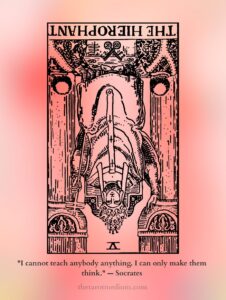
What Does The Hierophant Reversed Mean?
Reversed, The Hierophant splits into two stories, and both start in the same pew.
One version is dogma, teaching hardened into rules that stopped serving the people keeping them.
The other is rebellion, the necessary walk out the church doors toward something you actually believe.
Leaving the church, or becoming it
Discernment is the real question underneath both versions.
Some traditions deserve your loyalty, others your resignation letter. Telling them apart is adult spiritual work.
When this card reverses in a spread, I ask whether the structure is holding you up or holding you down.
The standard reading of The Hierophant reversed frames it as challenging the status quo, personal belief breaking from group convention.
The Hierophant reversed at a glance
- Core meaning: rules outliving their purpose, or the freedom found in finally questioning them.
- Relationships: unconventional love, pressure to formalize before you’re ready, or values drifting apart under one roof.
- Career and finances: chafing under company policy, a credential that no longer opens doors, advice from authorities who haven’t updated their map. Question the fee before paying it.
- Health: a second opinion worth seeking, wellness dogma taken past usefulness, the plan that works for everyone except you. Symbolic, never diagnostic.
- Spiritual: deconstruction, the faith of your childhood up for review, belief rebuilt by hand rather than inherited.
REVERSED KEYWORDS
dogma rebellion breaking convention restriction questioning authority nonconformity outdated beliefs deconstruction
CARDS THAT SHARPEN THE WARNING
- The Devil shows the dogma keeping someone chained to it.
- Eight of Swords convinces you the rules can’t be questioned.
- Ten of Wands measures the weight of obligations nobody actually assigned.
CARDS THAT SOFTEN IT
- The Star hands the leaver a faith of their own.
- Six of Swords makes the departure a passage instead of an explosion.
- Queen of Wands blesses the version of you that believes out loud.
“The founder of a school kills the school.”
Wallace Stevens“I cannot teach anybody anything. I can only make them think.”
Attributed to Socrates
The Hierophant Tarot Card: Quick Answers
Is The Hierophant a good card?
Yes. Upright, it points to guidance, belonging, plus wisdom you don’t have to invent alone.
Does The Hierophant mean marriage?
Often. It’s one of the classic marriage cards, especially beside The Lovers or Four of Wands.
What does The Hierophant mean in the future position?
A teacher, mentor, or committed path ahead, arriving through proper channels.
What number is The Hierophant in tarot?
Card five of the Major Arcana, right after The Emperor and just before The Lovers.
Where The Hierophant Might Be Pointing You Now
If The Hierophant keeps turning up for you, in a reading, a dream, a tarot deck you shuffle at midnight, it’s worth listening.
This card tends to appear right before people find the teacher, or become the one somebody else was praying for.
Yours might already be waiting with the door propped open.
When you’re ready to look at it with someone who’ll hold the whole picture, your reading is waiting.
Click here to book your reading to find which traditions still hold you, plus which ones love is asking you to outgrow.
Prefer to build the skill yourself? Learn how to read tarot cards online, without memorizing or a guidebook, one card, one connection, one lesson at a time.
Before you go, grab your free tarot notebook when you join the newsletter. Every pull you record becomes easier to look back on, so the patterns you’d otherwise miss start to surface.
Keep Reading
The Fool · The Magician · High Priestess · The Empress · The Emperor · Start reading
About the Author
Chris Bennett is the founder of The Tarot Medium, one of the world’s most highly rated, trusted psychic mediums and tarot readers. He received his first tarot deck at fifteen and now reads full time for clients around the world. Known for accurate, honest readings free of fear or theatrics, his work spans evidential mediumship, intuitive tarot, psychic life path readings, plus grief support rooted in real psychological depth. He offers secure online readings to clients across Canada, the United States, the United Kingdom, Australia, and beyond, alongside online tarot courses for anyone ready to learn. To book, visit thetarotmedium.com.
