

The Quiet Ways You Abandon Yourself for Love
Reading time: about 7 minutes.
Nobody warned you that you could disappear politely. One swallowed opinion at a time, a cancelled plan, or a “no, it’s fine” delivered with a smile you didn’t feel. Years of that, and one day you catch your reflection mid-laugh at something that isn’t funny, wondering who this agreeable stranger is.
If there’s resentment humming under your patience, exhaustion you can’t explain, a loneliness that somehow survives being partnered, you’re reading the right page. Those feelings aren’t drama or ingratitude. They’re the receipts of a long, quiet transaction, and you’ve been paying with yourself.
You’re not broken for having done this, you’re not the only one, and you belong here. Ahead is what self-abandonment actually is, the research on what it costs, the five disguises it wears, plus a way back to yourself that starts tonight with nothing more than a pen.
If you’ve never had a reading with me and want a sense of how I work, the tone, the boundaries, the clarity, you can click here to read what to expect from a reading with me.
For deeper guidance, exclusive offers, and first access to my most requested reading spots, click here to join my email list (I only send what’s meaningful, never spam, I promise).
One more thing before we begin. If you’d rather untangle this with me directly, you can book a private reading here. I won’t hand you verdicts about your relationship. I’ll hand you back your own clarity, which is worth considerably more.
Jump to what you need:
What does it mean to abandon yourself in a relationship?
You left. Nobody noticed, including you.
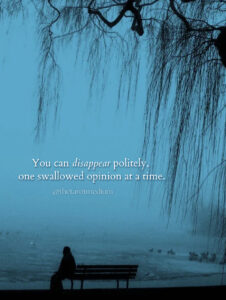
Self-abandonment is the slow trade of your inner world for someone else’s comfort. Your preferences, your opinions, your needs, your no, all quietly handed over in exchange for closeness, or at least the absence of conflict, which can impersonate closeness for years.
Nobody does this because they’re weak. People do it because somewhere along the line, usually early, they learned that their full self was too expensive for the people they loved. Shrinking got rewarded. Needing less kept the peace.
The cruelest part is how virtuous it feels from the inside. You’d call it being easygoing, low maintenance, selfless. Your body calls it something else, and it’s been filing complaints you’ve labeled as moodiness.
Why do I lose myself in relationships?
The blueprint was drawn before you could read.
Psychology gives this pattern a plainer name than fate. Attachment theory holds that our earliest bonds teach us what love costs, and a child who learned that affection arrived only when they were pleasing grows into an adult who treats their own needs as a liability.
People with an anxious attachment style are especially prone to this math. Closeness feels precarious, so they pay for it constantly, in accommodation, in vigilance, in becoming whoever the room requires. The relationship stays, technically. What leaves is you.
Understand this clearly: the pattern made sense once. It was a child’s brilliant solution to a situation no child should have to solve. A strategy that kept you loved at seven isn’t obligated to run your life at forty-seven, though, and recognizing it as a strategy rather than a personality is where the door opens. This is a lens, not a diagnosis, and if it’s touching something old, a good therapist is the right companion for that part of the road.
What are the signs you’re abandoning yourself for someone?
Five disguises, all wearing your face.

These rarely look dramatic. They look reasonable, mature, even loving, which is how they survive so long undetected.
The five quiet disguises of self-abandonment
- The pre-edited sentence. You rehearse everything before you say it, sanding off anything that might land wrong, until what comes out is technically true and entirely beside the point.
- The vanishing preference. Asked what you want for dinner, where to travel, what you think, you answer “whatever works for you” so reflexively you’ve forgotten it’s a dodge.
- The outsourced verdict. You judge yourself by their mood. A good day is a day they seemed happy with you, which means your worth closes and opens like a shop you don’t own.
- The apology reflex. You say sorry for having feelings, for needing time, for the weather. Somewhere you concluded your existence requires a permission slip.
- The scheduled self. The painting, the writing, the friendships, the faith, all postponed until some mythical season when nobody needs you. That season has a way of never arriving.
Count how many you recognized. Whatever the number, breathe. Recognition stings for a minute and serves you for years.
A gentle checkpoint before you read on
If you saw yourself in more of those than you expected, that recognition deserves care, not panic. A private reading with me is a calm moment to look at the pattern honestly and leave with your own footing back under you. You can book your session here.
Why do I go quiet instead of saying what I need?
Silence has a body count, and researchers kept score.
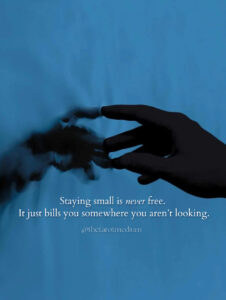
There’s a precise name for the biggest disguise of all. Researcher Dana Jack called it self-silencing: compulsive caretaking, pleasing, swallowing your own expression to keep a relationship intact. Her longitudinal research linked it directly to depression.
Decades of follow-up work have kept confirming the bill. Recent research ties self-silencing to higher anxiety and depression. The same work finds habitual self-silencers more vulnerable to gaslighting, since a person already doubting their own voice is easier to talk out of their own reality.
Read that again if you need to. The strategy you adopted to protect your relationships has been quietly taxing your health, your mood, your grip on your own perceptions. Staying small was never free. It just billed you somewhere you weren’t looking.
You can’t abandon yourself into being loved. You can only abandon yourself into being tolerated comfortably.
Is self-abandonment the same as compromise?
One is a bridge. The other is a toll you pay alone.
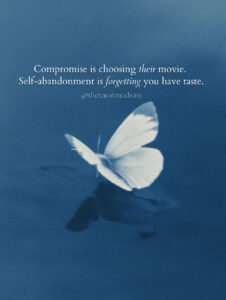
No, and the difference matters, since people in recovery from this pattern often overcorrect into treating every accommodation as a betrayal. Healthy love runs on compromise. Two full people meet in the middle, both visible, both occasionally disappointed, both still intact.
Compromise is choosing their movie tonight while knowing your taste still exists. Self-abandonment is forgetting you have taste. One is a decision made by a self. The other is the self quietly leaving the building while the smile runs the meeting.
Here’s the test I offer clients: after the accommodation, do you feel generous or erased? Generosity leaves you fuller. Erasure leaves a residue the anxious-avoidant dance loves to feed on, a low resentment that eventually surfaces sideways, as snappishness, as distance, as crying in the car over nothing in particular. The nothing was never nothing.
How do I stop abandoning myself in love?
The way back, as promised.

Returning to yourself isn’t a grand exit or a dramatic speech. It’s a series of small repatriations, three of them, each one preparing you for the next. A pen is the only equipment required.
Three repatriations, each one building on the last
- Reclaim one preference a day. Name what you actually want, out loud, in low-stakes moments. The coffee order, the restaurant, the movie. Trivial on purpose, since you’re not picking fights, you’re rebuilding a muscle that atrophied politely.
- Catch one edit in real time. Once a day, notice the sentence you were about to sand down, then say the original version instead. Watch what actually happens, not what your fear predicted would happen. Collect the evidence like the skeptic you secretly are.
- Write the unedited letter. Tonight, alone, finish this on paper, fast, before the internal editor wakes up: what I’ve stopped saying is… Keep the pen moving for five minutes, no crossing out, no softening. Nobody will read it, so tell the whole truth. The person who wrote that page is who you’ve been abandoning, and now you’ve met them again. Everything that heals from here starts with staying in contact.
Move gently with whatever that letter surfaces. Decades of silence don’t reverse in a week, and they don’t need to. You only need to stop leaving, one sentence at a time.
One warning before you go, since you’ve earned the honest version. People who stop abandoning themselves run into an uncomfortable discovery almost immediately: some of their relationships were built on the smaller version of them, and those relationships get noisy when the full person returns. A few people in your life love you. Others love what you do for them. Telling the difference between being loved and being needed is its own unsettling art, which is exactly where I’m headed next.
Where can I read more about love and the patterns beneath it?
If this resonated, here are a few more pieces worth your time:
- Repeating types: Pattern recognition
- Comfortable pain: Familiar faces
- Real or reflex: Honest love
- Ending well: Quiet exits
- Releasing outcomes: Open hands
If you enjoyed this article, I send out the occasional email that actually matters along with exclusive news and offers. You can join here without worrying about spam: subscribe now!
If this article resonated with you, book your private reading with me here.
About the Author
Chris Bennett is the founder of The Tarot Medium and one of the world’s most highly rated and trusted psychic mediums and tarot readers. He first picked up the cards more than twenty years ago and now reads full-time for clients around the world. Known for accurate, honest readings free of fear and theatrics, his work spans authentic evidential mediumship, intuitive tarot, psychic life path readings, and grief support rooted in real psychological depth. He offers secure online psychic readings, tarot consultations, and mediumship sessions to clients across Canada, the United States, the United Kingdom, Australia, and beyond. To book, visit thetarotmedium.com.
