
How Do You Know If You’re Meant to Be in a Relationship With Someone?
Reading time: about 7 minutes. Stay to the end for the one question I’d ask before any reading.
THE PRICE OF ADMISSION
Love was never meant to cost you the parts that make you who you are.
What a psychic medium sees when you ask if someone is meant for you, plus what to do if you feel trapped.
Is this person meant for me? I hear it in readings all the time. In fact it’s the most common question psychics and tarot readers get across the board.
It can tumble out in the first minute. Other times it slips in at the very end, almost like an afterthought saturated with emotion.
If you’re asking it right now, you might feel uncertain, lonely even with someone beside you, or quietly trapped. Those feelings make sense. You’re not alone, and you belong here.
Stay with me to the end of this. There’s one question waiting there that tells you more than any psychic can, plus the exact words to open the conversation you’ve been avoiding.
WHAT ARE YOU WONDERING?
Is this person meant for me? What am I giving up for love? Am I compromising or shrinking? Why do good couples drift apart? Is 80% sure settling? Do soulmates exist? What if I feel trapped? The one question to ask A tarot spread for readers
Standing at a crossroads in your relationship? Click here to book a reading. New to readings? Here’s what to expect.
What Are You Really Asking When You Wonder If Someone Is Meant for You?
The question under the question
It’s almost never about them.
When you ask if someone is meant for you, you’re usually asking whether you’re worthy of love, or whether you’ve been shrinking to keep the relationship. A relationship reflects how you’ve learned to love yourself. If staying costs you the parts that make you who you are, that’s your answer.
Underneath, you’re often wondering: Am I worthy of love? Have I been shrinking to keep this? Is this just the price of admission?
Wanting outside validation is human. Still, nobody else is in that relationship. You’re the one living it.
I see this all the time. You might be paying a steep price to stay, not because the love is worth it, but because being alone frightens you more.
What Are You Giving Up to Stay in a Relationship?
The parts that go quiet
Usually, the very part of you that makes you unique.
You might be giving up the very parts of yourself that make you unique: your intuition, spirituality, friendships, creativity or voice. If only one side of you is allowed to be seen in a relationship, it isn’t love. It’s control, which always comes from fear.
A quirk, a knack for noticing patterns, a sense of humour nobody else quite gets. Those nuances are easy to dismiss, yet they’re what make you human.
I see it most with women, made to feel they can only play one role: the nurturer, the provider. You’re so much more than that.
Hushed at dinner
I’ve watched it happen in real time.
A woman starts sharing something she believes. Her partner’s hand lands on her leg. Okay, that’s enough. Nobody here believes that.
Maybe someone at that dinner does. Either way, you deserve to say what you think, feel, hear, sense. Research on codependency shows how quickly our needs disappear when keeping the peace becomes the goal.
My own spiritual closet
Coming out of the spiritual closet felt scarier than coming out as gay.
Would this angel of a human being I adore think I was too strange? Making it all up?
We still don’t have deep spiritual talks. Travelling together showed me that’s okay. His price of admission was food; mine was spontaneity. Half the day for an adventure, half for a bakery. That’s life.
What’s the Difference Between Compromise and Sacrifice?
Two shapes, one feeling

Compromise is a blend. Sacrifice is a disappearing act.
Compromise is a blend, where both partners take turns meeting each other’s needs while still holding space for one another. Sacrifice, or shrinking, is moulding your personality to fit someone else. If you’re making yourself smaller to keep the peace, compromise has become sacrifice.
Crumbs on the counter
I did it too, over crumbs.
My partner is a trained chef. His kitchen is his sanctuary. If it wasn’t spotless when he walked in after a long day, you could feel it.
Each evening I’d scurry around wiping every surface before he got home. One day I stopped mid wipe. The kitchen was clean. His discomfort was his to carry, not mine.
Sitting him down was terrifying. Part of me thought, well, this is how it ends, over crumbs. It wasn’t. A weight lifted off us both. It was never about crumbs.
SIGNS YOU MIGHT BE SHRINKING
- You rehearse before sharing good news.
- You’ve stopped mentioning what earns an eye roll.
- You tidy, plan or perform to prevent a mood.
- Friends say they miss the old you.
- Being alone feels like relief, then guilt.
Why Do Couples Who Seem Perfect Drift Apart?
The waiting room trap
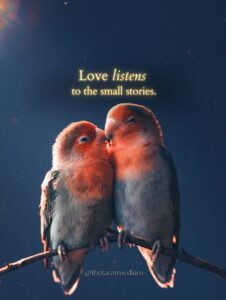
I’ve sat at weddings thinking, these two could not be better suited. Years later, they ended.
If your relationship once felt perfect, complacency is often what pulls you apart. One of you stops witnessing the other: dismissing small stories, staying glued to a phone, treating life like a waiting room. Over time, you stop sharing. Turning toward each other’s small bids for connection keeps love alive.
Nobody outside a relationship sees every nuance. One pattern shows up again and again, though: complacency.
It’s treating life like a waiting room. Wanting to be witnessed, while no longer witnessing the person beside you.
One partner shares the small things from their day. The other stays glued to a phone or a video game. Eventually, you stop sharing. What’s the point?
The Gottman Institute calls those small moments bids for connection. Couples who keep turning toward them tend to last.
Love isn’t a waiting room. It’s the practice of witnessing each other.
Is It Settling If You’re Only 80% Sure?
The missing twenty percent

To be honest? It’s a bit of both.
If you’re only 80% sure, you’re not automatically settling, though the missing 20% matters. If that 20% holds your values, your spirituality or the parts of you that search for meaning, the price of admission is too steep. Your values should never be compromised to keep a relationship.
If you’re reading this, you probably notice what other people miss. Maybe you’re drawn to places like the College of Psychic Studies, to synchronicity, to anything a little less conventional. Having that dismissed, over and over, wears you down.
The skeptic in my chair
A client once booked a reading for her husband. He arrived with his arms folded.
Even as I described who’d come through, plus how they’d passed, he gave nothing back. I ended the reading early.
Gently, I told him: if he could dismiss an experience his wife chose for him, she might not feel heard at home either.
I still think of her. Perhaps eighty percent of that marriage was steady. The missing twenty was the part of her searching for meaning.
Set the remote down
My own partner doesn’t meditate or read books.
He will, however, set down his controller mid game to hear about my day. I’m grateful for every one of those moments. That’s what makes it ours.
A CLEARER PICTURE
Wondering what your relationship is really asking of you? A reading can show you the pattern underneath, plus where your next step might lead.
Do Soulmates Really Exist?
One light, many mirrors

If I lose you here, I fully understand.
Soulmates exist, though perhaps not as one person for one person forever. A soulmate is the light in you recognizing the same light in someone else. Believing one person completes you edges toward codependency. You can love more than once; there’s no shortage of love.
I don’t quite believe in one person for one person forever. I’m also very monogamous, so let me explain.
I believe we’re all one spiritual being, temporarily experiencing the illusion of separation to learn about love. That idea runs through A Course in Miracles.
Coincidence? I don’t believe in it. Synchronicity, divine timing, absolutely.
Nobody completes you
The idea that one person completes you edges toward codependency.
In my mediumship readings, those in spirit want the same thing: for you to keep living. Life is for the living. There’s no shortage of love.
What Makes Love Last a Lifetime?
Seventy years next door

She met her husband when they were babies.
Love lasts when you witness each other’s lives. Lasting couples are often healing the same wound from opposite angles, balancing each other out. Over a lifetime, care, curiosity, simply paying attention to someone’s small stories, matter more than grand gestures.
I met her through my hospice bereavement group. They grew up next door to each other, then spent seventy years together until he passed.
Her secret? She always felt she wasn’t enough for him. He always worried he was too boring. Same wound, opposite angles.
I see that thread in so many lasting couples. You find someone healing the same wound from a different side, then you balance each other out.
What kept them going? She loved caring for him. They witnessed each other’s lives. The Harvard Study of Adult Development points to the same truth: warm relationships shape how well we live.
We’re here to witness each other. It really is that simple.
What Should You Do If You Feel Trapped in a Relationship?
When the small parts go missing

Here’s your sign: compromise has turned into sacrifice.
If you feel trapped in a relationship, notice whether compromise has turned into sacrifice. Then have a brave conversation somewhere outside your home: name what you’ve survived together, share how your needs have changed, ask about theirs. Be specific. Sometimes the need is simply to be heard.
Small parts of you have quietly gone missing. You’re playing a role that won’t let you grow, learn, or be witnessed.
That’s when you need to be very brave. The fear in your chest is valid. Have the conversation anyway.
Take it out of the house
Plan a date night somewhere other than home, away from where complacency lives. It doesn’t have to cost a thing.
Get dressed up for it. Sometimes what’s missing is simply seeing each other sparkle again, both of you.
WHAT TO SAY ON DATE NIGHT
- Look at what we’ve survived together.
- Knowing you has taught me this about love.
- My needs have changed, here’s how.
- Have yours changed too?
- What do you see us working toward?
Your partner probably isn’t as telepathic as you’d hope. Be specific. Sometimes your need is simply to be listened to.
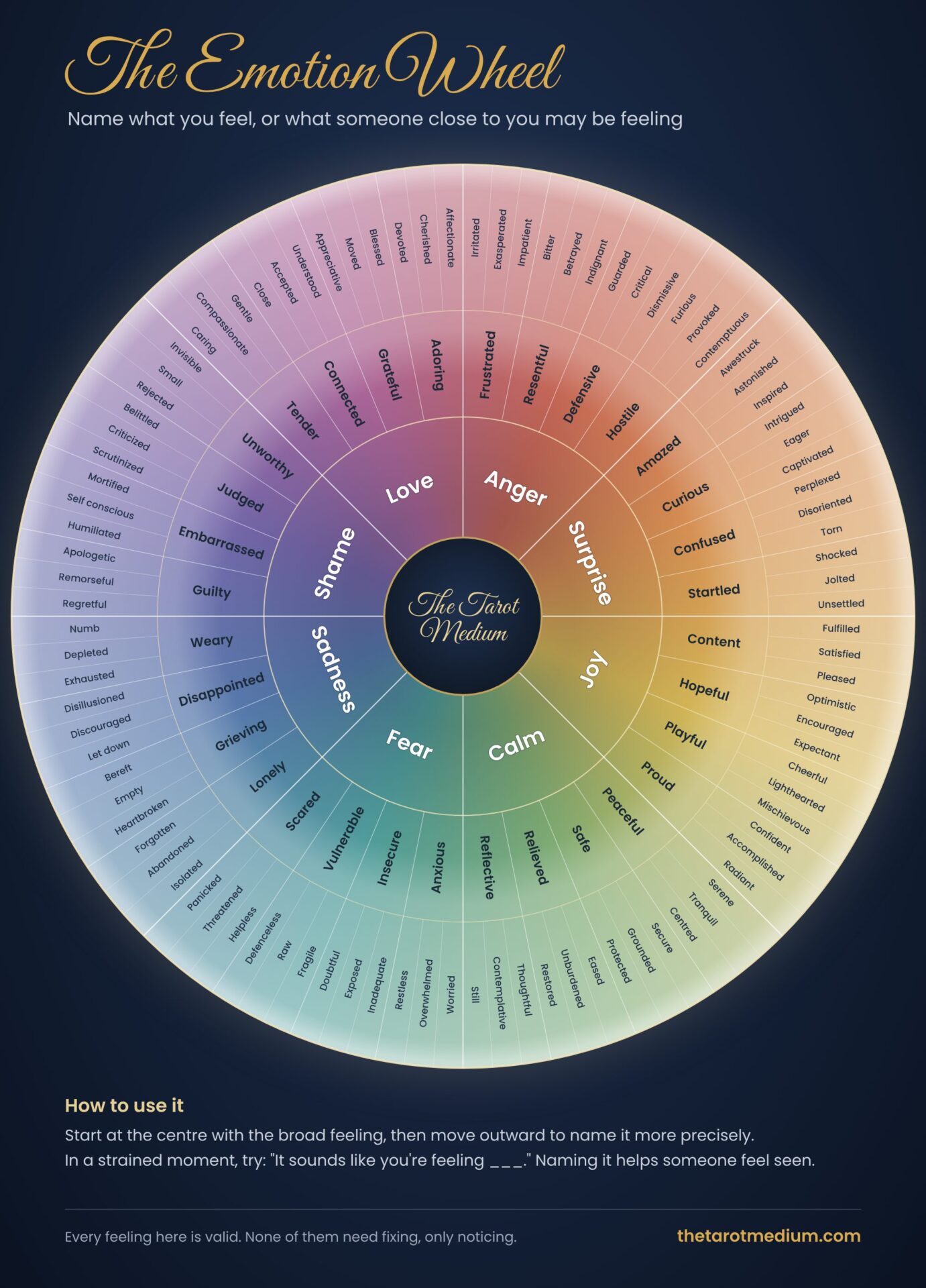
If they get defensive, stay steady: I just need to be heard. That’s it. Then ask about theirs. The Greater Good Science Center has more research on talking through difficult moments.
Ask for help
I learned this one with a binder full of receipts.
Stretched thin, I finally told my partner, I need your help. You’re good at this. His answer: I wish I’d known. Honestly, I should have asked sooner.
He’ll never change the aquarium water for our fish, mind you. You don’t have to do everything to prove you’re worthy of love.
What’s the One Question That Tells You If Someone Is Right for You?
The Witness Test
Forget fireworks for a moment. Ask yourself this:
The one question that tells you if someone is right for you: could I grieve beside this person? If you lost someone you love, would they hold you, listen, feed you, honour your wishes? How a partner shows up in loss reveals what your love is made of.
Could I grieve beside this person?
Everyone gets excited about falling in love. Nobody talks about the day loss arrives, which it will. That’s the moment love shows you what it’s made of.
THE WITNESS TEST
- If I lost someone I love, would they hold me through it?
- Would they ask gentle questions, witness my emotions, feed me?
- When I’m unwell, do they know what helps me feel better?
- Do they listen when I share something small?
- Would they honour my wishes, even at the very end?
Mostly yes? Protect what you have. Mostly no? That isn’t failure. It’s information, plus a conversation waiting to happen.
Either way, you deserve someone who witnesses your life. Next, I’ll walk you through telling your partner your needs have changed, without it turning into a fight.
WITNESSED
Look for someone who listens, someone you could grieve beside.
Is There a Tarot Spread for Knowing If a Relationship Is Right for You?
For my tarot readers
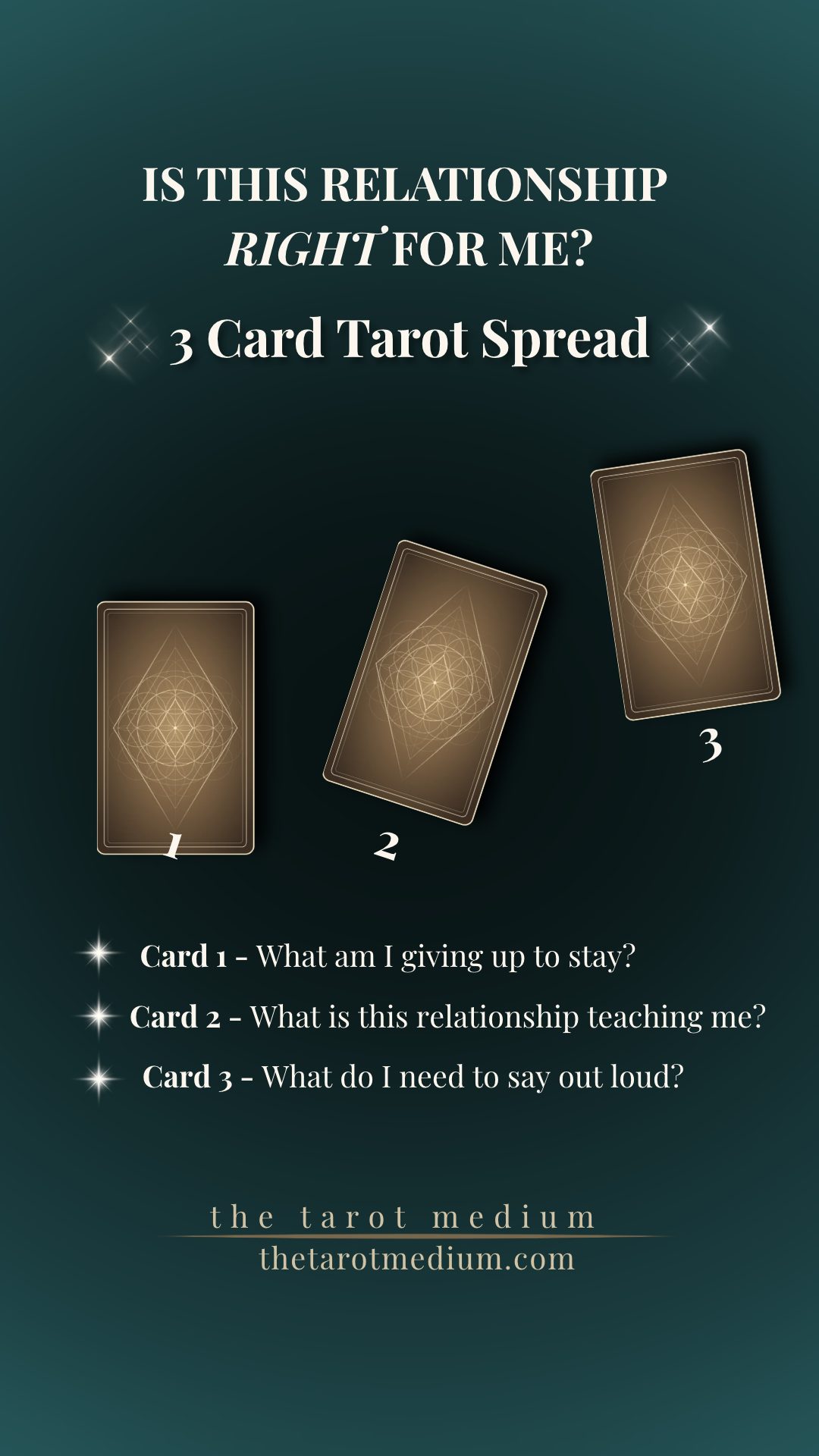
If you read tarot, this one’s for you.
The Is This Relationship Right for Me? tarot spread uses three cards: what you’re giving up to stay, what the relationship is teaching you, plus what you need to say out loud. It won’t give you a yes or no. It shows you the pattern, so your next step stays your own.
Shuffle your tarot deck while holding your relationship in mind, then pull three cards, setting them out left to right.
THE IS THIS RELATIONSHIP RIGHT FOR ME? SPREAD
- What am I giving up to stay? The part of you that’s gone quiet.
- What is this relationship teaching me? The lesson underneath the pattern.
- What do I need to say out loud? The conversation waiting for you.
Write down what comes up, especially if card three surprises you. Then bring it to your date night conversation.
If you’d like to read the cards on love yourself, Click Here to Explore the Tarot Courses!
Where Can I Read More About Love and Relationships?
Follow the one that pulls at you most:
- Lonely together: Alone beside them
- Healthy love: Seven secrets
- Warning signs: Toxic relationship signs
- Codependent patterns: Codependency or love
- Unavailable partners: Unavailable partners
- Healing heartbreak: After a breakup
If this article resonated with you, book your private reading here.
For a softer landing, here’s a guided meditation I recorded to nurture your self worth while aligning you with a balanced partnership. It’s lovely to drift off to, ideally every night for 21 days.
About the Author
Chris Bennett, known as The Tarot Medium, is a psychic medium, tarot reader and hospice volunteer whose approach is rooted in steadiness, clear perception, deep respect for what people are actually living through. His work is precise rather than dramatic, emotionally attuned without drifting into abstraction, honest without excess, often giving language to things people have sensed for a long time but couldn’t quite articulate. He reads online for clients across Canada, the United States, the United Kingdom, Australia, New Zealand and beyond, always beside therapy, never in place of it.
