

How Do You Survive the First Holiday Season After a Loss?
Reading time: about 12 minutes, with a three card spread at the end.
THE FIRST HOLIDAYS WITHOUT THEM
You’re missing your greatest witness.
Why the first Christmas after a death can feel heavier than the funeral, what actually helps you get through it, plus how your loved one in spirit still shows up, from a psychic medium who volunteers in hospice.
Picture the empty chair at Christmas dinner. Most people do when they think about grief during the holidays, because it’s the clearest picture of what’s missing: your greatest witness in life, sometimes the very heart of your home.
When the holidays arrive without them, everything still happens. The lights go up, the music plays. Somehow it all feels a little flat, as if the bubbles in the champagne have quietly gone still.
If this is your first holiday season after a loss, this one’s for you. I’ll share what I’ve learned through hospice, through thousands of readings, through my own family at Christmas.
WHAT ARE YOU CARRYING?
Why does it hurt this much? Is Christmas worse than the funeral? How do I get through it? Can I skip the holidays? What do I do with their empty chair? How do I answer people? Do they visit at Christmas? Is it wrong to feel joy? Any tarot spread for this?
Never had a reading with me? Curious about the tone, the boundaries, the clarity? Click here to read what to expect.
Join the newsletter for your own free tarot notebook, a quiet place for whatever this season stirs up.
Missing someone this Christmas? Click here to book a reading.
Why Do the Holidays Hurt So Much After Someone Dies?
The one who made it feel special
When someone you love dies, you lose the person who witnessed your life. They knew your history, remembered the year the tree fell over. They’d pick up the phone on Christmas morning, laugh at the photo you sent, make the whole day feel like it mattered.
Holidays are built on that kind of witnessing. Every tradition quietly asks, who’s here with me? When the answer has changed, the season holds up a mirror to the gap.
A Christmas I walked into
Some of you who’ve followed my writing from the beginning may remember this. When I met my husband, he’d lost his mom two years earlier. Our very first Christmas together, he asked his dad to put up the lights, bring home a tree, decorate the house again.
I didn’t think much of it. I simply wanted to be part of his family for Christmas: his dad, his brother, him. Over nearly ten Christmases since, I’ve witnessed grief move through that home in layers. What I’ve learned is simple. The ache isn’t about the decorations or the meal. It’s about missing the one who made it feel like home.
Is It Normal to Dread the Holidays After a Loss?
Absolutely, yes

Dreading the holidays after a loss is one of the most normal parts of grief. You might dread birthdays too, New Year’s, anniversaries, any day meant to be marked.
Each one asks you to go through the motions without the person who’d answer your call, the one whose voice you could hear on the other end. Celebrating anything can feel like a disservice to them, or to yourself. Moving forward without them feels too contrasting, almost like a betrayal.
Even a spark of joy can bring guilt with it. That’s not a flaw in you. It’s love trying to stay loyal.
Holiday reminders are a well documented grief trigger. The Mayo Clinic notes that planning ahead for these moments, rather than bracing alone, can soften their weight.
Why Does the First Christmas Feel Worse Than the Funeral?
The numbness wears off
This is a heavy one. Losing your mother, your father, your spouse, your child: a funeral can feel like a bomb went off, leaving you standing there in the numbness. It’s never easy. Still, it gives your love somewhere to go. It gathers people, reminding you what love looks like.
Christmas is different. It arrives slowly, carrying weight. You notice the traffic picking up a month early, everyone racing somewhere. In the northern hemisphere it lands in the darkest part of the year.
There’s a societal pressure, wherever you are in the world, to celebrate, to show up, to be with family. Meanwhile your love has nowhere to land. You might even dread hearing their name, because it reminds you they aren’t there.
A funeral marks the loss. The first Christmas asks you to live inside it.
Light and shade, together
Hospice taught me that the first holidays after a loss tend to feel surreal, numb, almost alien. Think of all the highlights of someone’s life. Many of them happen at Christmas, which is exactly why the season magnifies every low.
You can’t paint a masterpiece with highlight or shade alone. Both are needed. When life hands you a bright moment, it illuminates the shade you’re carrying, which is why the joy of the season can make the grief feel sharper, not softer.
How Do You Survive Your First Christmas After Losing a Parent, Partner or Child?
Survive is the key word
There’s no one answer here. Survive is the key word, which means you don’t have to perform.
That’s the trouble with Christmas in particular: people feel pressure to look fine. After profound loss, there’s no societal marker for where you are. Nobody can see it. Sometimes people expect you to be further along, even years later.
Wherever you are is perfectly valid. You’re not alone reading this.
Memories are the bridge

Say their name. Bring them into focus. Remember what you enjoyed about being with them, the Christmas moments that still make you smile.
I don’t mean the platitude that they live on in your heart. I believe memories are the bridge between us and them. Our thoughts don’t always belong to us; we witness them. When a loved one shows up in your mind, they’re often trying to help you feel something.
Try this: a first Christmas plan
- Choose one tradition to keep, one to pause.
- Decide ahead of time where you’ll be, so you aren’t deciding on the day.
- Pick one person you can text when it gets heavy.
- Plan a small moment for them: a candle, a toast, their favourite song.
- Give yourself permission to leave early, without explaining.
Is It Okay to Skip the Holidays This Year?
Yes, with one gentle nudge
Absolutely. There’s no reason to celebrate if you don’t feel like it. If I lost my partner tomorrow, it would take me a long time to make sense of who I am outside that relationship. Loss takes a piece of your identity too.
Still, through bereavement work as a hospice volunteer, I’ve learned that community is key for healing. It’ll feel like stepping outside your comfort zone, and that’s okay. You might feel warmth you don’t think you deserve yet. Nobody expects you to say a word.
A woman who never said a word
One woman in a support group stays with me. She’d known her husband since they were babies, next door neighbours who became high school sweethearts. He died at seventy. Now in her mid seventies, she’d lost her greatest witness to life.
She didn’t speak once during the group. At the end, I asked what she’d gotten out of it. She told me she’d never believed in support groups, never pictured herself at one. Simply hearing that others were living the same kind of loss made her feel less alone, and she got to carry that home with her.
You can heal through other people, even if you only listen.
If you accept an invitation, you can be honest at the door: “I’m still very tender. I appreciate you, I may need some space.” Then let that be enough. The Canadian Virtual Hospice gathers more ideas for coping with grief during the holidays.
Should You Keep the Old Traditions or Start New Ones?
Both, whatever holds you
There’s no right or wrong answer. Old traditions can keep a sense of who they were close: a special ornament, a dish they always brought, the way they set out the stockings. These are the places where they live on.
New traditions are welcome too. Nothing is set in stone. Some people only celebrated because it mattered so much to their partner, so honouring those rituals keeps them near.
The boxes in the basement
That first Christmas with my husband’s family, I noticed something. There were so many boxes of decorations, and the heart of that home had been missing for a while. I asked them to bring every box up for the tree.
It wasn’t as sad as I expected. No single ornament broke anyone open. Each one, though, would bring a brief pause. I’d watch someone hold it for a second, quietly realizing their mom may have been the last person to touch it.
When I saw that pause, I’d ask, “Tell me what that one means to you.” It would start off sad, then turn nostalgic: a memory from when they were small, when she was very much alive. Then it went on the tree.
It was cathartic, also an honour to witness. Layers of feeling that had been compartmentalized for so long came out through those old decorations, as if they’d been holding everything the family couldn’t say.
What Do You Do With Their Empty Chair at Christmas Dinner?
Light a candle where they sat

You can absolutely keep a placeholder there. Personally, I’d urge you to light a candle where they used to sit, unless a friend or family member fills that seat with love.
Your loved ones in spirit still witness you. They show up as warmth on your skin, a sudden memory, a shift in the room that’s easy to dismiss. You don’t have to be psychic to feel it.
How my mother in law arrives
I never met my mother in law physically. She shows up when her boys are laughing, remembering her, all of them together with her husband.
Four of us in the kitchen at Christmas is a little like an indoor camping trip. When the conversation goes quiet, I sometimes ask, “Tell me more about your mom. What would she have done this time of year?” Even if I’ve heard the story before, a new layer comes through. Laughter follows, then more stories.
That’s when I feel her. It’s a physical warmth, as if candles were lit all around us when none are. It feels like someone is watching me with love, with acceptance. In my mind’s eye I see her with her hands over her heart, simply admiring her boys.
This is how mediumship works through the clairs: clairsentience as warmth, clairvoyance as that image. Thousands of readings have taught me to trust it. I’d be surprised if her family didn’t feel it too.
Read the room. When it falls quiet, invite them in.
How Do You Handle Family Who Act Like Nothing Happened?
Their way isn’t yours
That’s perfectly valid too. Some people cope by not touching it. I respect that, and I’d gently encourage you to as well.
I see grief as jumping headfirst into ice cold water, screaming underwater until you can’t feel anything except the cold. Surfacing is slow. Catching your breath takes time.
Being around family at Christmas can feel just that sharp. You might feel grayscale while everyone else is in colour, out of place, wanting to curl up and disappear. Nothing needs fixing; let it be true. If that feeling sounds familiar, this piece on why grief rarely looks how we expect goes deeper.
What Do You Say When Someone Asks How You’re Doing?
Moment by moment

I’ve never been a fan of small talk, and you don’t owe anyone a performance. One answer I love: “Moment by moment, I’m moving forward.” That’s exactly what you’re doing.
I learned that from a colleague who ruptured his Achilles tendon but still had to show up to work. Twenty or more people a day asked how he was doing. Every time, he answered, “I’m healing up moment by moment,” or “I’m healing up faster than ever.”
At first you could hear the pain behind it. One day I asked if it was just an affirmation. He said, “What do I have to lose? I can tell them it feels like a red hot coal under my foot, or I can tell them the truth, that I’m healing.” He did heal, faster than anyone expected. It was remarkable to witness.
THINGS YOU CAN SAY
- Moment by moment, I’m moving forward.
- I’m missing them so much right now.
- Honestly, I just need a hug.
- Being around people is tough, but I’m here.
- I might need a little space today.
Anything you say is valid, including nothing at all.
How Can You Support Someone Who’s Grieving at Christmas?
Name what they’re feeling
Be gentle. Read their nonverbal cues. Notice whether their arms are closed, whether they’re withdrawing, numbing out or drinking more than usual. Maybe they’re curled up with the dog, or playing with the kids to stay busy.
If they bring their person up, try, “Tell me more about them.” You can also help label what they’re feeling: “I can only imagine how sad this must be for you.”
As soon as you name someone’s emotion, they feel seen, which is often exactly what’s missing. Research backs this up: a UCLA study on affect labeling found that putting feelings into words calms the brain’s alarm response.
Do Loved Ones in Spirit Send Signs at Christmas?
Synchronicity is everywhere, if you look
Signs are different for each person. Synchronicities surround us all the time; the more you meditate, reflect or pray, the more you notice them.
COMMON CHRISTMAS SIGNS
- 11:11 on the microwave or the car clock
- A cardinal outside your window
- A hummingbird, even as an image somewhere unexpected
- An angel symbol appearing where you least expect it
- Lights flickering, especially old Christmas lights
- A familiar scent with no source
Old Christmas lights have turned on by themselves in front of me. I’ve watched garage lights flicker for a father who was no longer here, in the one place he loved to hang out. For more on telling a real sign from wishful thinking, here’s my guide to signs from spirit.
A Christmas that changed forever
One client lost their dad at Christmas to suicide. A loss like that tears a hole through everyone. People wonder if it was their fault, if they could have said something different. There’s no clean closure, only questions.
That time of year will always carry a heaviness for them now. Mental health struggles often stay silent, hidden beneath the face someone shows the world. Some of the people who make everyone else laugh are carrying the most.
Their dad loved to smoke. On Christmas Day, they smelled cigarette smoke in the garage when nobody had been out there. They knew it was him.
If this season feels like too much
You don’t have to carry it alone. In Canada or the United States, call or text 9 8 8. Samaritans are on 116 123 across the UK and Ireland, while Lifeline in Australia is on 13 11 14. A grief counsellor can also walk beside you; my readings are a supplement to that support, never a replacement.
How Do You Honour a Loved One Who’s Died at Christmas?
Small rituals, big love

Say their name. Share what they meant to you, what you learned about love through knowing them.
WAYS TO HONOUR THEM
- Light a candle at dinner where they’d sit
- Hang an ornament with their name on it
- Print photos of favourite moments, frame them, place them around the tree
- Cook their signature dish, the way they made it
- Raise a toast with a story only they could star in
- Write them a Christmas card, then read it out loud
Photos are one of my favourites. They remind you what it looked like when they were here, when they were happy. Grief researchers call this kind of ongoing connection continuing bonds, a healthy way of carrying love forward rather than letting go of it.
They’re still alive, in a different form. The form changes; love doesn’t.
Is It Wrong to Enjoy the Holidays After Someone Dies?
Life is for the living
It isn’t wrong. My grandmother used to say, “Life is for the living.” I never got to meet her; she died at thirty eight. Those words are hers, though, and they’ve stayed with me.
Enjoying the holidays, a birthday, a spark of joy, even yearning for companionship after losing a partner, can all bring guilt. People feel guilty for laughing because it seems like they should still be deeper in mourning. Some worry joy means they’re avoiding the grief.
All of that is understandable. The guilt is still something you can release. Your loved one in spirit wants you to let go, not of them, but of the guilt, the anger, the frustration that came with their ending.
If that guilt sits heavy, talking to them directly can help more than you’d expect.
Is There a Tarot Spread for the First Holidays After a Loss?
The Empty Chair Spread
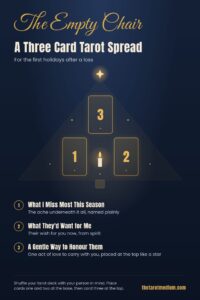
For my fellow tarot readers, this one’s for you. If you don’t read tarot, each position works as a journal prompt too.
Shuffle your tarot deck slowly while holding your person in mind. Pull three cards, placing them left to right.
The Empty Chair Spread
- What I miss most this season: the ache underneath it all, named plainly.
- What they’d want for me: their wish for you now, from spirit.
- A gentle way to honour them: one act of love you can carry this Christmas.
Position one reflects what you’re feeling underneath everything. Seeing it there, validated, is part of healing. Awareness of what’s causing the pain is the first step, even if you’ve walked this road before.
Position two might ask you to feel a deeper layer of loss, or nudge you toward family. If a joyful card shows up, like the Sun (XIX) or the Ten of Cups, that’s the right answer too. A memory may come flooding back here, which is the bridge between you and them.
Position three could be anything. If a heavier card arrives, like the Five of Cups or Death (XIII), it may point to something you’re ready to release. Letting go feels counterintuitive to feeling them, yet that’s the essence of love. We don’t bring anything with us except the love we felt, received, gave.
Unsure what a card means? Every one is waiting in the complete tarot glossary.
FORM CHANGES
We’re simply witnessing each other. The love is what you get to keep.
Where Can I Read More About Grief at Christmas?
Follow the one that pulls at you most:
- Christmas grief: Christmas truths
- Holiday tips: Twelve tips
- Lonely seasons: World moving
- Before goodbye: Anticipatory grief
- Phone reflex: Still reaching
- Peace after: Finding peace
Before you go, grab your free tarot notebook when you join the newsletter. Thoughtful, grounded, never spam.
If this article resonated with you, book your private reading here.
About the Author
Chris Bennett, known as The Tarot Medium, is a psychic medium, tarot reader and hospice volunteer whose approach is rooted in steadiness, clear perception, deep respect for what people are actually living through. His work is precise rather than dramatic, emotionally attuned without drifting into abstraction, honest without excess, often giving language to things people have sensed for a long time but couldn’t quite articulate. He reads online for clients across Canada, the United States, the United Kingdom, Australia, New Zealand and beyond, always beside therapy, never in place of it.
